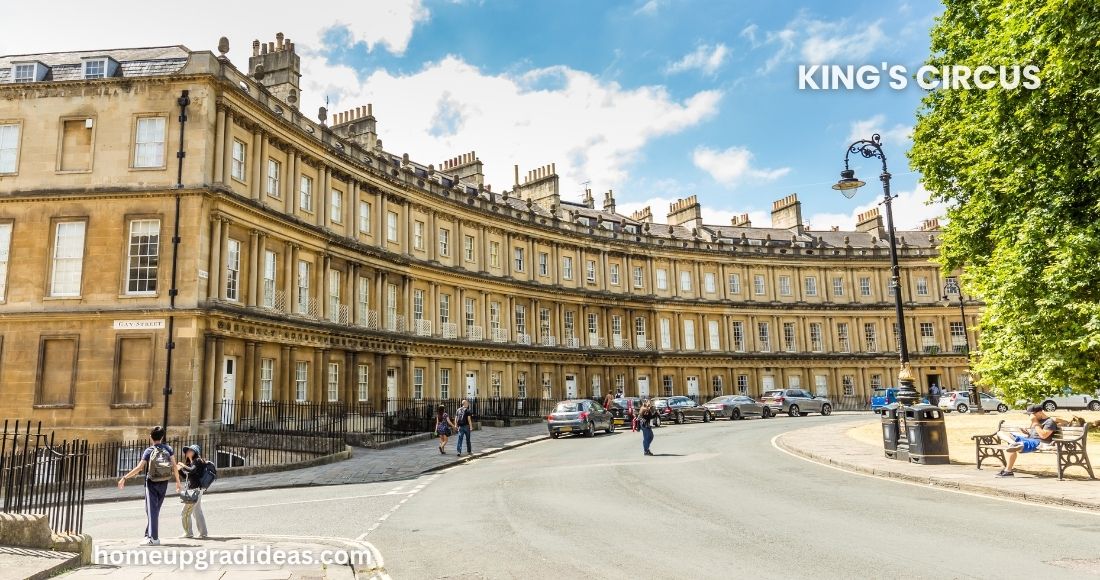
King’s Circus stands as one of Bath’s most photographed and celebrated addresses, a perfect ring of golden stone townhouses that has captivated visitors for over 250 years.
Designed by John Wood the Elder, this Palladian landmark blends Roman grandeur with mythical British history. Walking into Kings Circus feels like stepping back into Georgian England, where every curved facade was crafted to impress.
Three equal entrances ensure a flawless classical view greets visitors no matter which road they take. Beyond its striking beauty, Kings Circus carries deep historical weight, having sheltered statesmen, painters, and explorers within its walls.
Names like Pitt the Elder, Gainsborough, and Livingstone all once called this circular address home. Today, King Circus remains a coveted residential location and a must see stop for anyone exploring Bath’s UNESCO World Heritage streets.
Its Grade I listed homes blend original Georgian character with modern luxury living. From its Doric, Ionic, and Corinthian columns to its symbolic acorn finials, King’s Circus rewards close inspection at every turn.
This article explores its design, history, famous residents, and the rare properties available within its storied curve.
What Is King’s Circus In Bath?
King’s Circus is one of Bath’s most iconic addresses. It is a circular space surrounded by grand townhouses built in warm Bath stone.
John Wood the Elder designed this Palladian masterpiece in the 1750s. He drew inspiration from the Roman Coliseum and ancient Britain to shape his vision.
The structure turns inwards, facing a shared enclosed garden. This design creates a powerful sense of arrival for every visitor.
Every curved segment faces one of the three entrances. This ensures a perfect classical facade greets you whichever way you enter.
The foundation stone was laid in 1754. John Wood the Younger completed the design by 1768 after his father’s death.
The Architectural Vision Behind King’s Circus
John Wood the Elder believed the circle to be a perfect form. His design reflects ideas rooted in Druidical circles and a Divine proportional system tied to Solomon’s temple.
He linked the layout to King Bladud, the mythical founder of Bath. He also connected the site to Stanton Drew, seeing those ancient stones as a precedent.
Wood built the Circus to match the diameter of Stonehenge. He personally associated that monument with a moon temple and druidical temples on Lansdown hill.
Key Architectural Features
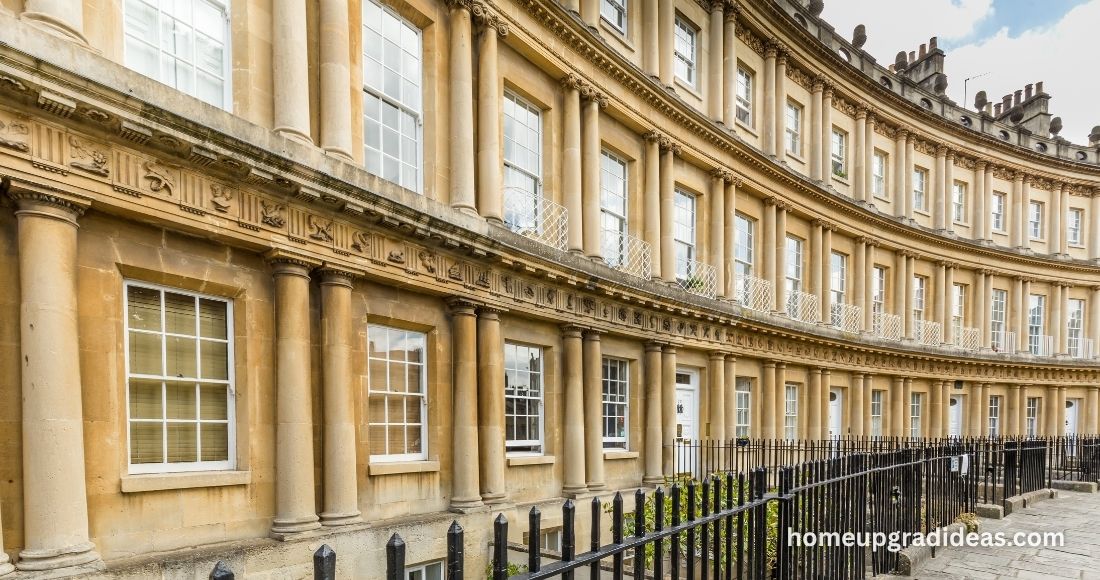
The Doric entablature carries 525 carved emblems. These include serpents, nautical devices, Masonic emblems, fables, and military trophies on the metopes.
Columns rise through Roman Doric, Ionic, and Corinthian orders from street level upward. Garlands and female masks connect the upper Corinthian capitals.
The acorn finials crown the parapet above. A balustrade topped with pineapples finishes the topmost level with precision and character.
History Of King’s Circus
King Circus, originally called the King’s Circus, carries centuries of rich history. It began as a paved courtyard hiding a reservoir beneath its surface.
John Wood the Elder poured his intellectual passions into this project. His love of Imperial Roman architecture and ancient Britain shaped every detail.
The south western side has always held the greatest prestige. Properties here sit on classic Bath stone beneath a slate tiled roof.
In 1942, the Baedecker Blitz sent a bomb through several houses. Each damaged property was carefully rebuilt to match the original Georgian style.
By the 1920s, the Circus had become home to professionals. The high number of doctors in residence earned it the nickname Pill Box.
Construction Timeline Of Kings Circus
The earliest record appears in an engraving dated c.1754. It predates the construction of both Brock Street and Bennett Street entirely.
The south west segment broke ground in 1755 and finished in 1767. The south east segment followed from 1762 to 1766, and the northern segment rose from 1764 to 1766.
The full project took fifteen years to complete. It delivered 33 houses across three segments, with the site spanning roughly 100 yards in diameter.
Restoration And Maintenance Through The Centuries
Soot blackened and corroded Bath stone was cleaned in the late 1950s. This work restored the warm golden tone that defines the streetscape today.
Later in the 19th century, tenants began lengthening first floor windows. The motivation was likely light, hygiene, and the pull of fashion.
Each phase of restoration respected the original Georgian architecture. The equidistant entrance roads and enclosed character of the space were always preserved.
Famous Residents Of Kings Circus
King’s Circus has housed some of Britain’s most celebrated historical figures. William Pitt the Elder, Thomas Gainsborough, and William Makepeace Thackeray all lived here.
Plaques fixed to several houses mark where these figures once resided. They serve as permanent heritage markers across House 7 through to House 27.
William Pitt the Elder, serving as Earl of Chatham, lived at No. 7 from 1755. He was among the very first lease holders at the Circus.
The Corporation honoured Pitt with the freedom of the city in a gold casket in 1757. He later served as MP and led the Bath General and Mineral Water Hospital.
By 1763, a dispute over a peace treaty with France and Spain ended his time in Bath. He sold his house and left the city permanently.
Thomas Gainsborough At King Circus
Thomas Gainsborough lived at No. 17 between 1767 and 1774. Records also link him to No. 24, where he produced some of his most celebrated works.
His finished canvases travelled to the Royal Academy through Wiltshire of Shockerwick House. This route made his Bath work visible to the wider art world.
Gainsborough’s presence added enormous cultural prestige to Kings Circus. His years here remain one of the most celebrated chapters in the address’s long history.
Other Notable Residents Of Kings Circus
House 9 commemorates Frederic Lord Leighton, while House 13 honours Dr David Livingstone. House 14 marks the home of Robert Lord Clive, known as Clive of India.
Major John Andre lived at House 22, and Rear Admiral Sir William Edward Parry occupied House 27. Each name connects the Circus to a distinct chapter of British history.
Philip second Earl Stanhope purchased No. 5 in 1755 and added No. 6 in 1784. The Circus consistently attracted the most ambitious and influential residents of the era.
Where Is King’s Circus In Bath?
King’s Circus sits north of Queen Square, reached by walking up Gay Street. It connects westward to the Royal Crescent along Brock Street.
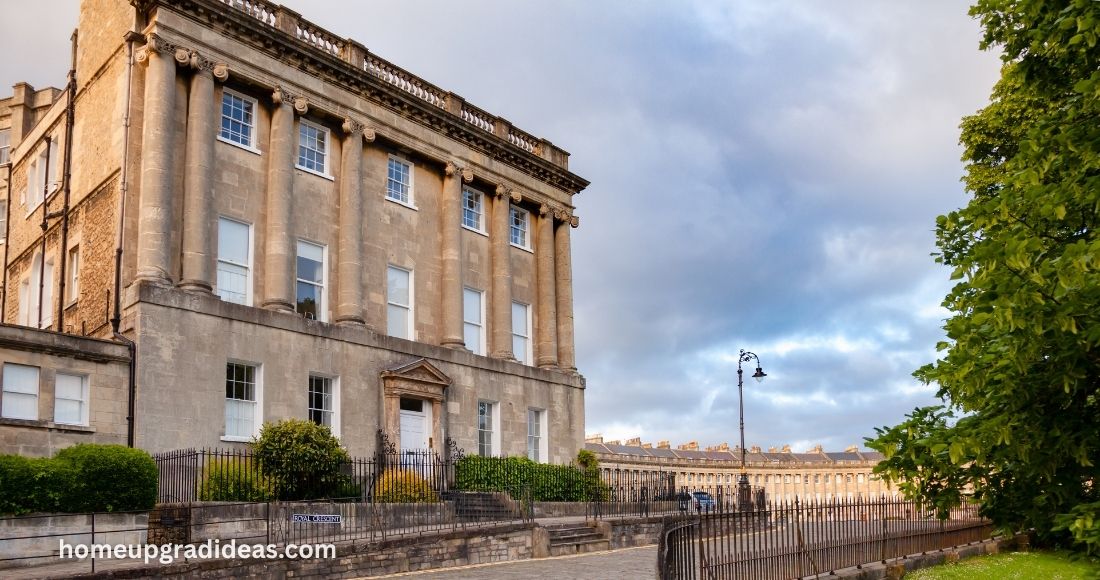
Bath’s best shops, restaurants, and cultural attractions sit only a minutes walk away. The Theatre Royal and Bath’s Festivals Trust events add greatly to the local draw.
Bath itself is a World Heritage Site celebrated for its Roman heritage and Georgian architecture. It offers cultural facilities, leisure, sports, and shopping across a compact centre.
The mainline rail link connects Bath to London Paddington in around 90 mins. Bristol Temple Meads is just 15 mins away by train.
Drivers will find Junction 18 of the M4 roughly 11 miles north of the city. Arriving on foot up Gay Street gives the best first view of the sweeping curved facade.
The Plaque At Kings Circus
A plaque fixed to the railings near the entrance from Bennett Street carries the official inscription.
This small heritage marker is easy to overlook but deeply rewarding to find. It gives full credit to both architects at the very point of entry.
John Wood Senr and John Wood Jnr share the acknowledgement equally. For anyone passionate about Georgian Bath, this plaque is a direct link back to 1754.
Properties Inside King’s Circus
Living inside Kings Circus means owning a piece of genuine Georgian history. Both 8 The Circus and No. 26 represent the finest residential offerings the address holds.
Each property carries full Grade I listed status and sits in a truly world famous address. The south west views across Victoria Park make these homes extraordinary.
The Bath stone exteriors, slate tiled roofs, and acorn finials define the outward character. Inside, sash windows and extravagant cornicing set the tone throughout.
The Gravel Walk, made famous by Jane Austen, runs directly behind these properties. A pedestrian gate at the rear of each garden opens straight onto it.
Both properties reflect the Palladian ambitions of John Wood the Elder. They stand as living proof that Kings Circus remains as relevant today as it was in the 1750s.
8 The King’s Circus A Georgian Townhouse Of Rare Quality
8 The Circus extends across 6,100 sq ft and five floors. The grand entrance hall features a stone staircase connecting all upper floors and lower floors.
The ground floor holds a kitchen, breakfast room, reception room, family room, and formal dining room. A glazed walkway links the interior to the garden beyond.
The first floor delivers a paired drawing room and withdrawing room. Sash windows frame the central trees of the Circus and the rear views toward Victoria Park.
The principal bedroom on the second floor forms a full suite with a shower room and dressing room. The top floor offers three bedrooms and dedicated bath rooms for family accommodation.
The lower ground floor adds a sixth bedroom, a barrel ceiling sitting room with a street entrance, a utility room, and access to two vaults.
26 The King’s Circus A Palladian Beauty Restored
No. 26 spreads across 7,000 sq ft and six floors, fully restored from a previous apartment conversion to its original single family layout. The Georgian architectural past is entirely intact.
Elaborate cornicing, exceptional detailing, and large sash windows survived the restoration process completely. Fans of Bridgerton will instantly recognise the spirit of the space.
Stacked reception rooms, halls, dining spaces, and withdrawing rooms fill the entertaining floors. A chef’s kitchen, gym, wine cellar, and landscaped garden bring it fully into modern use.
The listing was handled by Jack King at Savills for £5 million. The Georgian splendour of every room makes No. 26 one of the most significant homes the king’s circus has ever offered.
Final Thoughts About King’s Circus
King’s Circus remains one of the finest examples of Georgian town planning ever created, a testament to John Wood the Elder’s bold architectural vision. Its circular design continues to inspire architects and delight visitors after more than two and a half centuries.
From its mythical ties to King Bladud and Stonehenge to its real history of statesmen and artists, Kings Circus offers layers of meaning behind every facade. Few addresses anywhere blend legend and history so seamlessly into daily life.
For homeowners, King Circus represents a rare chance to live within a genuine architectural icon rather than simply admire one from outside. Properties like 8 The Circus and No. 26 prove the address still meets modern expectations.
Whether you’re drawn by the Doric carvings, the famous former residents, or the sweeping curved streetscape, Kings Circus rewards every visit and every closer look. It stands today exactly as Wood intended timeless, dignified, and unmistakably Bath.
A walk up Gay Street to King’s Circus remains one of the most rewarding routes in the city, blending world class architecture with living history. It is, quite simply, Georgian Bath at its finest.
FAQs About King’s Circus
What Is The Circus, Bath, And Why Is This Georgian Landmark So Iconic?
The Circus, Bath is a stunning Georgian circle of townhouses designed by John Wood the Elder, a true architectural treasure.
Are King’s Circus Tickets Needed, Or Can Visitors Explore This Free Landmark Freely?
No King’s Circus tickets are needed this beautiful Grade I listed landmark is a free, open public space to enjoy.
What Do King’s Circus Reviews Say About Visiting This Beloved Bath Attraction?
King’s Circus reviews praise its breathtaking architecture, peaceful lawn, and unforgettable Georgian charm in Bath.
Is The Circus, Bath For Sale, Or Are These Homes Privately Owned Residences?
The Circus, Bath is not for sale as a whole individual townhouses occasionally appear on the property market.
What Makes King’s Circus, Bath, A Must See Georgian Architectural Masterpiece?
King’s Circus, Bath, dazzles with curved terraces, intricate stonework, and a timeless, majestic Georgian elegance.